Why are we doing this work?
Our culture provides a sense of belonging
The Giga̱me’dzikas “Many Chiefs” project, through the Kumugwe Cultural Society is aimed at the reconciliation, restoration, and repair of Kwakwakw’wakw cultural significance and territorial governance, leadership and systems. We aim to revitalize traditional leadership in our Kwakwaka’wakw communities to address the cultural gaps between hereditary chiefs and their families by assembling hereditary chiefs to discuss what is needed to restore their leadership to namima and their namima’s place in the culture of the Kwakwaka’wakw.
Hereditary chiefs had stewardship over the land. This created a sense of belonging. What belongs to the namima (clan house) the government disrupted.
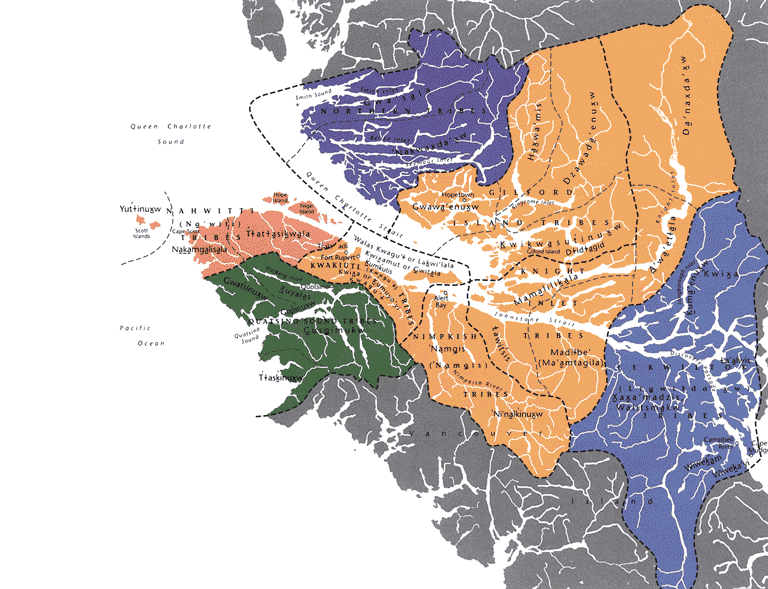
Culturally, the traditional community includes 15 tribes comprising of seventy-seven namima (clans).
Kwaguł, Mamalillikalla, Namgis, Tlawitsis, Da’naxda’xw ,Ma’amtaglia, Kwikwasutainukw, Gwa’wainukw, Tsawatainukw ,Walitsma, Wi’wakai, Wi’wakum, Nakwaktakw, Gwasala, Pentlatch, E’iksan, K’omoks.
Na̱nwakola
“Discussing things to produce the right solutions.”
Inviting people to discuss the needs of their ‘na’mima and community is a powerful way to solve problems. The old chiefs and matriarchs worked to draw wisdom to the house floor for millennia. Everyone in the house was considered a vessel for wisdom and leadership. Both men and women were viewed in this light. Our leaders met around food, song, and story and shared ideas and needs. A chief (host) provided food from his ‘na’mima territory and gave generously. He did not hold back. Feast songs were sung, and a story was shared to set the tone for the discussions. Everyone was heard. Reflection on what was said was an important part of the meeting process. Sometimes, the reflection was for a couple of days. Then, decisions were made.
Key Moments in Indigenous History
This timeline, created by Historica Canada, identifies key moments in the history of Indigenous peoples across this land.